Budapest, December 10, 2024 – What does it take for not just the common areas of an
office building, but also a tenant’s own office space to receive the highest certification in Hungary?What does this mean for employees? What must developers take into account? And on what criteria is the certification awarded? These were the key questions explored by the members of the AmCham Workspace and Facilities Management (WFM) Committee during their November visit to the office of MSD, an innovative pharmaceutical company.
Zsolt Kákosy MBA MRICS, Senior Director of ICON Real Estate Management and Chair of the AmCham WFM Committee, explained in his opening remarks that the MSD office, located in Budapest’s Millennium Gardens, is the first in Hungary to receive a WELL certification. Until now, only common areas of buildings had achieved this prestigious standard – this is the first time tenant areas have qualified. In today’s economic environment, forward-thinking commitments like this prove that setting the bar high is worth it. Such offices can significantly improve employee well-being and help attract and retain top talent.
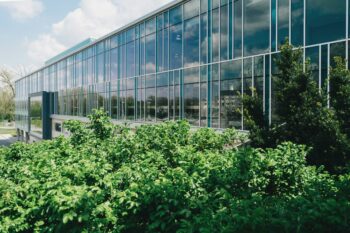
Károly Dömötör Makk, Leasing Director at TriGranit, noted that achieving BREEAM Excellent certification was a goal from the design phase. The building was also the first to earn Access4you Gold classification. He emphasized that offices supporting employee well-being aim to retain highly skilled and hard-to-replace professionals.
A truly modern office that offers a high-quality employee experience must today consider elements such as natural shading techniques (to reduce cooling costs), EV chargers, car wash facilities, dedicated bike storage, showers, changing rooms, a 21st-century canteen, selective waste collection, and motion sensor LED lighting. The developer even installed bat houses on the building to help preserve the local wildlife ecosystem.
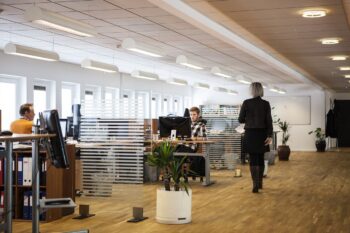
Orsolya Simon, Communications Manager at MSD, highlighted that the relocation and office design were carried out with employee involvement. From the number of meeting rooms to the quality of coffee machines, staff opinions were sought throughout, supported by a dedicated change management team. The 1,552-square-meter office, operating with a hot desk system, fully adheres to MSD’s high international standards and its commitment to healthy office environments and employee well-being.
Comfortable, efficient, and ergonomic workspaces are ensured by electrically height-adjustable desks. With 23 meeting rooms of various sizes and configurations equipped with modern technology, there’s a suitable space for every work style. In addition to collaboration-supporting communal areas, there are quiet zones, acoustic phone booths, and focus rooms. The office features unique interior design with colorful acoustic panels, high-quality furniture, and an abundance of plants. Employees also have access to a nursing room and massage chairs, and barrier-free facilities and furniture support people with disabilities.
According to Regina Kurucz, WELL AP consultant at REWELL Consulting Ltd., WELL certification evaluates spaces based on a range of factors such as air quality, water quality, lighting, encouragement of physical activity, use of healthy materials, thermal comfort, acoustics, community services, and support for mental health. Five of these – air and water quality, thermal comfort, acoustics, and lighting – are verified through on-site measurements.
MSD’s Budapest office received the WELL certification in January 2024, becoming the sixth MSD office globally to earn it – a remarkable achievement. The global pharmaceutical company has launched the WELL certification process at 46 locations worldwide. The WELL certification provides verified, audited data to support companies’ sustainability and ESG reporting. In Hungary, BP’s Budapest office also holds WELL accreditation. The certification is not limited to offices – any community space designed for prolonged occupancy or accommodating large groups, such as airports, cultural venues, or sports centers, may also qualify.
The goal is to enable people to spend time in high-quality environments – whether during work or leisure.